By Matthew Dobson
Monday, March 4, 2025
Toronto—The year 2025 marks a defining moment in the global race for artificial intelligence (AI) supremacy. In just the first six weeks of the Trump administration, the United States has mobilized over $2 trillion US dollars in AI-related investment, both from the government and the private sector, and implemented an aggressive strategy to cement its leadership in AI. This strategy combines deregulation, energy infrastructure overhauls, massive capital deployment, and geopolitical maneuvering to accelerate AI industrialization between 2025 and 2027.
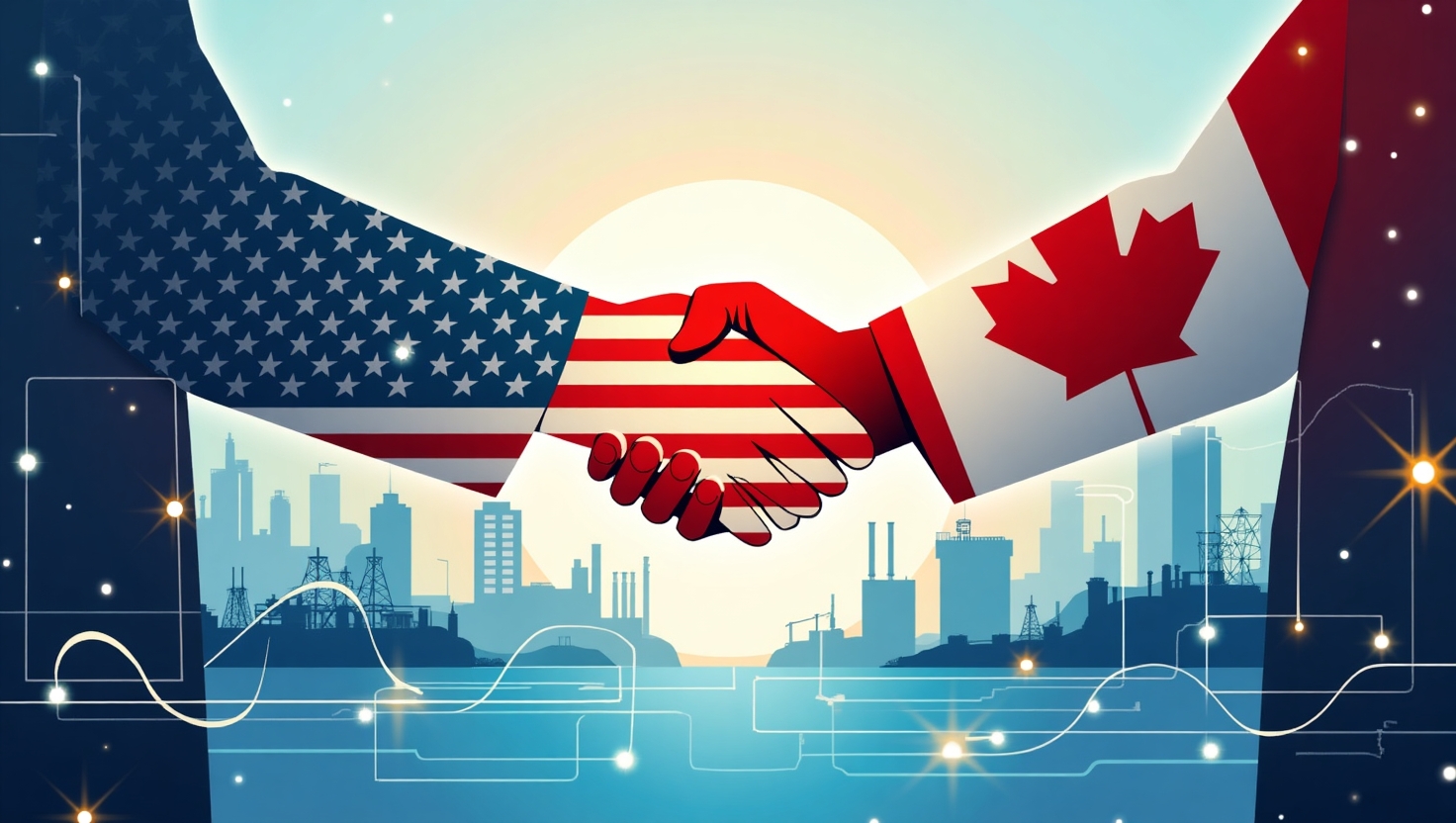
At the same time, the administration’s March 4, 2025, tariffs on Canadian imports—including a 10% tariff on Canadian energy products—raise questions about whether this is simply an economic policy or part of a broader negotiation tactic to secure energy supplies from Canada to power AI infrastructure. The rhetoric about making Canada the “51st State” may simply be a high-stakes energy acquisition strategy, as the U.S. needs short-term fossil fuel imports to meet its AI-driven power demands.
Below, we break down the key elements of this strategy and how the U.S. has rapidly positioned itself as the dominant force in AI.
Deregulation to Accelerate AI Innovation
One of President Trump’s first executive actions after taking office in January 2025 was repealing Executive Order 14110, a Biden-era directive that placed regulatory constraints on AI development. This repeal removed:
• AI Safety Testing Requirements – AI developers no longer need to submit safety test results to the federal government.
• Workforce Protections – Restrictions on AI-based hiring and lending decisions have been lifted.
• Transparency Standards – Watermarking of AI-generated content is no longer required.
With these constraints removed, the administration aims to foster an “unrestricted innovation” environment for American AI companies.
Additionally, Executive Order 14179, issued on January 23, 2025, directed federal agencies to identify and eliminate AI-related policies that hinder growth within 60 days and mandated that the Office of Science and Technology Policy (OSTP) deliver a national AI growth strategy within 180 days.
The result has been a surge in AI investments, particularly in computing infrastructure and energy development.
The $500 Billion Stargate Initiative: Mobilizing AI Capital
On January 21, 2025—just one day after taking office—President Trump announced the Stargate Initiative, a $500 billion AI infrastructure project designed to position the U.S. as the global leader in AI industrialization.
The initiative is backed by major players, including:
• OpenAI (operational lead)
• SoftBank (financial lead)
• Oracle (data center expertise)
• UAE-based MGX (investment partner)
• NVIDIA, Microsoft, and Arm (technology providers)
Implementation Timeline:
• Phase 1 (2025–2026): Construction of 20 AI mega-data centers in Texas, each 500,000 square feet, powered by nuclear and geothermal energy.
• Phase 2 (2027–2028): Expansion to 50 nationwide facilities, creating 100,000 new jobs and delivering 5 exaflops of AI computing capacity.
This initiative directly counters China’s $8.2 billion AI development fund, demonstrating that the U.S. is determined to outspend and outbuild its competitors.
Energy Infrastructure Overhaul to Meet AI Demand
Recognizing that AI requires massive amounts of power, Trump issued Executive Order 14156 on January 20th, 2025, which declared a national energy emergency and prioritized AI-related energy projects. This executive order allows for:
• Fast-tracked approvals for AI-energy projects, bypassing National Environmental Policy Act (NEPA) reviews.
• Grid modernization efforts, ensuring AI facilities receive the required 5–8 gigawatts of annual power—enough to power 5 million homes.
The policy prioritizes AI power needs over decarbonization efforts, ensuring a stable and cost-effective energy supply to sustain AI-driven industrial expansion.
Private Sector Mobilization: The $1.5 Trillion AI Capex Surge
The combination of deregulation and public-private investments has triggered an unprecedented $1.5 trillion in private sector AI infrastructure investment. Major U.S. tech firms are aggressively scaling their AI capabilities:
• Amazon AWS – $100 billion in AI infrastructure, including expansion of Trainium2 AI chips and global data centers.
• Microsoft – $80 billion to support OpenAI and cloud-based AI workloads.
• Google (Alphabet) – $75 billion for AI training compute and data centers.
• Meta – $60–65 billion to deploy 1.3 million GPUs for AI processing.
• BlackRock – $100 billion Global AI Infrastructure Investment Partnership (GAIIP)
BlackRock: Architect of AI Infrastructure Partnerships
A major force behind the private sector mobilization is BlackRock, which has launched the Global AI Infrastructure Investment Partnership (GAIIP) with Microsoft, Global Infrastructure Partners (GIP), and UAE-based MGX. The $100 billion initiative aims to build AI data centers and energy infrastructure, with an initial $30 billion in private equity funding.
Key Objectives of BlackRock’s AI Strategy:
• Energy-Data Center Integration – Combining renewable energy projects (solar, wind, and nuclear) with AI data centers to address decarbonization challenges. NVIDIA serves as the technical advisor, optimizing infrastructure for AI workloads.
• Economic Impact – BlackRock’s CEO, Larry Fink, estimates that GAIIP will unlock a $2 trillion long-term investment opportunity by aligning private capital with national AI competitiveness goals.
This partnership solidifies the U.S. as the global hub for AI infrastructure and energy alignment, ensuring AI expansion continues at an unprecedented pace.
Short-Term Dependence on Canadian Fossil Fuels (2025-2027)
While the U.S. rapidly builds out its AI infrastructure, it cannot immediately meet its energy needs domestically and will rely on Canadian fossil fuel imports to bridge the gap.
Key Factors Driving This Dependency:
• Surging AI Energy Demand – AI data centers require 5-8 gigawatts of power annually. While nuclear and geothermal energy are prioritized, fossil fuel backups are necessary for stability.
• Canadian Natural Gas & Oil as a Strategic Supply Source – Canada provides 50%+ of U.S. crude oil imports, delivered through existing pipelines (Keystone XL, Enbridge, and TC Energy NGTL).
• U.S. LNG Exports & Domestic Supply Constraints – Record U.S. LNG exports to Europe and Asia create domestic supply shortages, making Canadian natural gas imports essential.
The U.S. will depend on Canadian fossil fuels through 2027, before transitioning to domestic nuclear and renewable energy.
Conclusion: The AI Industrialization Strategy and the Role of Canada
The United States has embarked on the largest AI industrialization initiative in history, mobilizing over $2 trillion US dollars in public and private sector capital within just six weeks of the Trump administration. The sheer speed and scale of this effort—most of it rolled out within days of January 20th inauguration—combined with the fog of stale guidance from the media and a void of any leadership has left Canadians here in Toronto, Ontario scrambling to comprehend what we are actually dealing with.
This isn’t just about border security, or nominal trade imbalances. And this isn’t just about AI. This is about energy, economics, and geopolitics on a scale Canada has never faced. AI requires massive amounts of power, and while the U.S. is aggressively building nuclear and renewable capacity, it needs Canadian fossil fuels through 2027 to bridge the gap. The March 4, 2025, tariffs on Canadian imports, alongside Trump’s rhetoric about making Canada the “51st State”, are not just economic or border moves—they are likely a high-stakes negotiation tactic to secure long-term, stable, and discounted access to Canadian energy.
The real question is: Why aren’t Canadians paying attention? The U.S. is already winning the AI arms race, and energy is the next battlefield. AI dominance will be decided as much by energy control as by computing power.
If you want to understand America’s agenda, follow the money. This is the biggest mobilization of capital, infrastructure, and resources since the Cold War, the Space Race and wartime industrialization. Trump and Musk aren’t just making noise—they are symbols of US Government and Industrial solidarity, and a new AI-driven economic and geopolitical order.
And yet, from here in Toronto, it seems Canada is asleep at the wheel. Meanwhile, these dynamics are at play, and the United States—Government and Industry—is ALL IN and playing the game to WIN.
How can Canadians compete, position themselves or even begin to respond and negotiate mutually beneficial energy and trade deals if we don’t even understand the scope and scale of what’s really happening in the United States?
🔥 Toronto, it’s time we all wake up! We all need to get smart fast, get organized, and get in the game. Together and collectively.
Join the AI Guild of Toronto. Get involved with like minded professionals in the Greater Toronto Area and let’s play to compete and win, together.